
 Article
 Brochure
 Executive Resource
 Insight Hub
 Ext. Publication
 Video
VideoAI Risk Governance Starts With Decisions, Not Controls

Never miss a thing.
Sign up to receive our insights newsletter.

Most artificial intelligence (AI) risk programs fail for a simple reason: they start with controls before they understand risk. Organizations rush to write policies, deploy monitoring tools or stand-up ethics committees often without first agreeing on what kind of AI they are governing. The result is predictable: low risk use cases buried under excessive process and high-risk systems operating with insufficient oversight. This early misalignment creates governance friction at one end and blind spots on the other, increasing operational exposure while slowing responsible innovation.
A more effective approach is decision-first AI risk governance. Instead of leading with controls, the process begins by clarifying the nature of the AI system itself and the decisions it influences.
A Decision‑First Approach to Understanding AI Risk
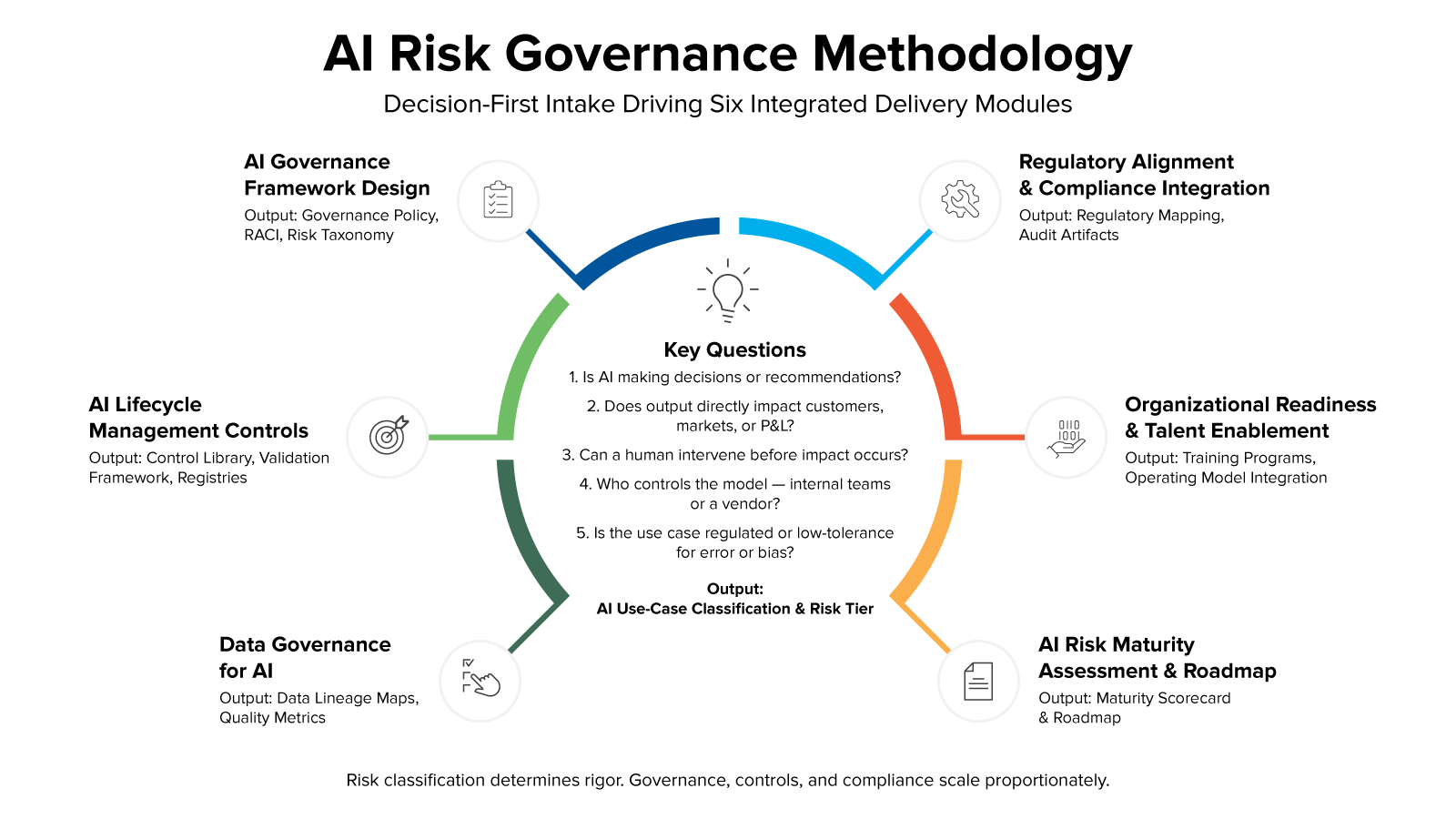
A more effective approach is decision-first AI risk governance. Before governance frameworks or controls are designed, AI use cases should answer five foundational questions:
- Is AI making decisions or providing recommendations?
- Does the output directly impact customers, markets or financial results?
- Can a human intervene before impact occurs?
- Who controls the model — internal teams or a vendor?
- Is the use case regulated or subject to low tolerance for error or bias?
These questions are not theoretical. Each answer materially changes risk exposure, and therefore, the level of governance required. Together, they classify AI systems into clear risk tiers creating a defensible basis for proportional oversight. The decision profile becomes the anchor point for all downstream governance activities.
From Decision Classification to Practical Governance
Integrated delivery modules
Once risk is classified, governance becomes practical rather than theoretical. As illustrated in the methodology diagram, a decision-first intake drives six integrated delivery modules:
- AI governance framework design
- Regulatory alignment and compliance integration
- Organizational readiness and talent enablement
- AI risk maturity assessment and roadmap
- Data governance for AI
- AI lifecycle management controls
Importantly, these modules do not apply uniformly. Their depth and rigor scale are based on how AI is actually used, not how the system is described. This prevents organizations from overbuilding governance in low‑risk areas and under-investing where decision impact is highest.
Where organizations go wrong
This is where many organizations go wrong. AI systems described as “decision support” often behave like decision engines in practice. Human oversight exists on paper but not in workflows. Vendor-managed models introduce risks that internal controls were never designed to address. Without clear decision classification, these mismatches remain hidden and often become visible only after something breaks, triggering reactive remediation, regulatory scrutiny or even reputational damage.
The Principle of Proportional Governance
Effective AI risk governance accepts a simple truth: not all AI requires the same controls. What it requires is consistency in how risk is assessed, clarity in who owns decisions and discipline in aligning controls to real-world impact.
The guiding principle is straightforward:
- Risk classification determines rigor.
- Governance, controls and compliance should scale proportionately.
Organizations that adopt this mindset can move faster with low-risk AI, govern high-risk systems more credibly, and more importantly, can explain why their governance looks the way it does to boards, regulators and auditors alike.
This is what distinguishes an AI risk framework from a functioning AI risk operating model.
Weaver Helps Operationalize Decision-First AI Governance
As AI becomes embedded in core business processes, decision‑focused risk governance provides the structure organizations need to scale safely and responsibly. By anchoring controls to decision impact, leaders gain clarity, teams gain flexibility and oversight becomes both credible and explainable.
Our team can help translate these principles into practical operating models that fit their goals, risks and maturity. Contact us today. Let’s discuss how we can support your AI governance journey.
©2026
