
 Article
 Brochure
 Executive Resource
 Insight Hub
 Video
Video Ext. Publication
Climate Risk Assessments: Turning Uncertainty into Strategic Insight

Never miss a thing.
Sign up to receive our insights newsletter.

Climate risk is a near-term business issue that directly affects asset values, insurance availability, supply chain reliability and access to capital. Boards and executives are increasingly expected to understand how climate-related disruptions could impact operations and financial performance, not just next year, but over the life of their most significant investments.
Climate risk assessments provide organizations with decision-grade insight into these exposures. By translating physical and transition risks into financial and operational terms, they enable leaders to make informed choices about capital planning, risk mitigation and long-term strategy before disruption forces reactive decisions.
Understanding the Risk Landscape
A climate risk assessment begins with a deep dive into both physical and transition risks. Physical risks include acute hazards like hurricanes, wildfires and floods as well as chronic challenges such as rising temperatures and sea-level rise. Transition risks encompass regulatory changes, carbon pricing, evolving market preferences, technological disruption and reputational expectations. Together, these risks shape an organization’s operational continuity, capital planning and long-term strategic direction.
The financial stakes are substantial. For the world’s largest companies in the S&P Global 1200, climate physical risk costs are projected to reach $885 billion annually in the 2030s, rising to $1.2 trillion in the 2050s. The average electric utility faces projected costs of $4.6 billion annually in the 2050s without adaptation measures. These aren’t abstract numbers. They represent real facilities, real disruptions and real financial consequences that demand proactive management.
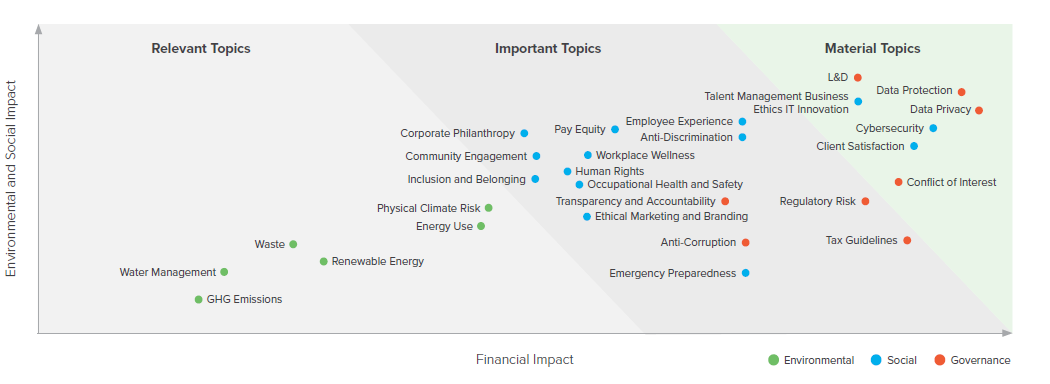
These financial implications underscore why organizations need a structured way to identify which climate risks require immediate attention. To support that prioritization, Weaver’s double materiality assessment evaluates climate risks and opportunities through both financial and broader impact lenses. This framework helps leadership distinguish where climate exposures intersect with strategic, operational or stakeholder-driven considerations and where focused action can create the most value. The graphic below illustrates how double materiality sharpens this analysis.
Strengthening Enterprise Risk Management
When integrated into enterprise risk management (ERM), climate risk assessments move from theoretical analysis to practical risk governance. Rather than existing as a standalone study, climate risks can be embedded into risk registers, internal audit planning, insurance renewals and business continuity strategies. This allows organizations to evaluate climate exposures alongside other material risks, prioritize mitigation efforts and provide boards with a clearer view of how long-horizon climate scenarios could affect cash flow, asset values and operational resilience.
The Regulatory Imperative
Regulation is also pushing climate risk assessment from optional to essential. Standards such as Australia’s ISSB S1/S2, CSRD and state-level legislation in the U.S. (including California’s SB 261) require entities to disclose climate-related risks and opportunities. Even when reporting is not mandatory, organizations use assessments to prepare for future regulatory expansion, align internal systems with global norms and ensure their data is audit-ready. Organizations that invest early are positioning themselves for a smoother and less costly compliance pathway.
Uncovering Hidden Opportunities
Beyond compliance, climate risk assessments uncover operational efficiencies and new opportunities. Insights often reveal redundancies, vulnerable assets, unoptimized processes or opportunities for cost-saving investments such as energy efficiency upgrades, resilient infrastructure or supply chain diversification.
Walmart provides a compelling example of turning climate risk into competitive advantage. The retailer launched Project Gigaton, challenging its direct Tier 1 suppliers to collectively cut one gigaton of greenhouse gas emissions from their operations by 2030. The initiative wasn’t purely altruistic — Walmart itself saved nearly $1 billion in a single year and cut almost 650,000 tonnes of CO2 emissions through its own climate initiatives, proving that climate risk management directly impacts profitability.
Other organizations have discovered entirely new business opportunities through their climate assessments. An industrial equipment maker conducting climate risk analysis identified new product ideas, a retailer spotted electrified delivery options and a conglomerate discovered a promising adjacent market they could enter. When you understand your vulnerabilities, you also see where unmet needs exist.
The Power of Scenario Analysis
A high-quality climate risk assessment includes scenario analysis, evaluating multiple plausible climate futures to understand how risks may change over time. This helps organizations make informed decisions about capital allocation, resource planning and long-term strategy. Scenario analysis also strengthens confidence from investors and insurers who increasingly expect organizations to test their resilience under varied conditions.
Building Long-Term Resilience
When paired with strong governance and internal controls, climate risk assessments become a foundation for transparency and resilience. They allow organizations to communicate their preparedness to stakeholders, build trust, differentiate themselves in competitive markets and demonstrate a proactive approach to risk and opportunity management.
What Organizations Gain from a Weaver Climate Risk Assessment
Weaver helps organizations turn climate uncertainty into informed action. A Weaver climate risk assessment produces practical, defensible outputs leadership can use immediately:
- Quantified physical and transition risks translated into financial and operational impacts
- Scenario analysis aligned to recognized frameworks and regulatory expectations
- Board-ready insights that support capital planning and strategic decisions
- Documentation designed to be audit-ready and reusable across reporting regimes
- Integration with existing ERM, governance and internal control structures
Our approach integrates sustainability, risk, finance and operations, ensuring climate risk assessments are not isolated exercises, but strategic tools embedded into how organizations plan, govern and invest. By delivering decision-useful insights and durable frameworks, we help clients strengthen resilience, meet evolving expectations and position themselves for long-term value creation. Contact us for a consultation.
©2026
