
 Article
 Brochure
 Executive Resource
 Insight Hub
 Ext. Publication
 Video
Employee Health Benefit Cost Increase Set for Largest Since 2003

Health Care Valuation Services

Health Care Valuation Services
Never miss a thing.
Sign up to receive our insights newsletter.

Health Care Valuation Implications
The total health benefit cost per employee is expected to accelerate meaningfully in 2027, as employers project the largest increase in health benefit costs since 2003. Several factors are contributing to the increase, including growing use of GLP-1 medications, artificial intelligence (AI)-enabled provider coding and billing, and rising costs associated with advanced medical technologies.
While employers have absorbed several years of rising health care costs, projected increases in 2027 may prompt more significant changes to benefit design, reimbursement strategies and cost-containment efforts.
By the Numbers
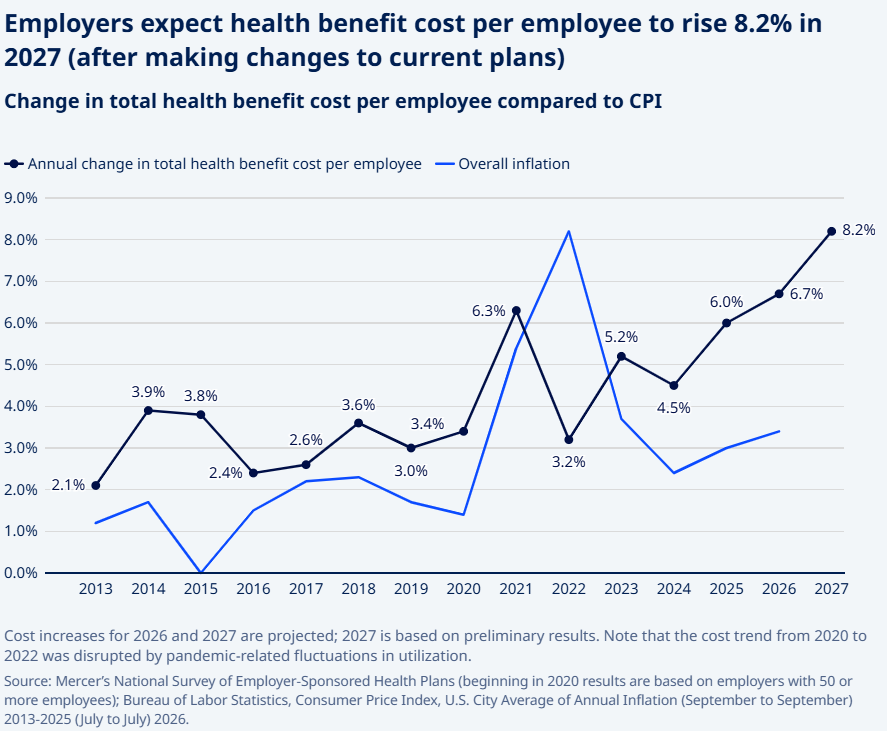
The graphic below highlights the steady acceleration in employer-sponsored health benefit costs, culminating in the highest projected increase in more than two decades. The trend underscores growing pressure on employers, insurers and providers as health care cost growth continues to outpace broader inflation.
Source: Mercer
- Employers expect health benefit costs per employee to increase 8.2% in 2027, the highest projected increase since 2003.
- Cost growth has accelerated from 4.5% in 2024 to 6.0% in 2025, 6.7% in 2026 and 8.2% in 2027 (projected).
- Health benefit cost growth is projected to outpace overall inflation in 2027 by a substantial margin, continuing a long-term trend in which health care costs rise faster than overall inflation. This gap could put additional pressure on employer benefit budgets and influence decisions about plan design and cost sharing.
Why it Matters
- Plan design changes are likely. Employers are expected to increase employee cost sharing and deductibles in 2027. Providers could experience stronger reimbursement pushback as employers and insurers seek to offset escalating benefit costs. Higher out-of-pocket costs could also lead some patients to delay or forgo care.
- The widening gap between health care inflation and overall inflation increases health care’s growing importance within employer budgets and benefit planning. As health benefits consume a larger share of compensation spending, employers may face difficult tradeoffs between wages, benefits and overall workforce investment.
- Health insurers are likely to intensify AI-driven initiatives to deny or reduce provider claims, which may affect revenue per patient and mitigate contractual reimbursement increases. Providers may need to account for greater scrutiny of claims and potential reimbursement disputes when assessing revenue expectations.
Health Care Valuation Takeaways
- As employer health care costs continue to outpace overall inflation, commercial payers will face increasing pressure to limit premium increases, creating downstream pressure on provider reimbursement rates. Valuators should consider adding additional future reimbursement risk for commercial payors into the valuation analysis.
- Higher deductibles, increased co-pays and greater eligibility friction could affect patient volume as patients defer care. Valuators should assess how increased patient cost sharing could affect utilization, patient volume and related revenue assumptions.
- Providers may face a difficult combination of slowing reimbursement growth and continued labor and operating cost inflation, placing downward pressure on EBITDA margins and valuation multiples. Valuators should closely monitor exposure to commercial pricing pressure and slowing patient volume growth and monitor the effects on normalized profit margins. Organizations with greater exposure to commercial reimbursement may be particularly sensitive to these dynamics.
As employer health benefit costs rise, health care providers may face greater reimbursement pressure, changes in patient utilization and continued margin compression. Weaver can assess how these factors may affect financial forecasts, normalized earnings and valuation conclusions. Contact us to discuss your health care valuation needs.
©2026
