
 Article
 Brochure
 Executive Resource
 Insight Hub
 Ext. Publication
 Video
How the No Surprises Act Is Reshaping Provider Reimbursement

Health Care Valuation Services

Health Care Valuation Services
Never miss a thing.
Sign up to receive our insights newsletter.

The No Surprises Act has created a meaningful new reimbursement opportunity for certain health care providers. Claims resolved through the federal independent dispute resolution (IDR) process can result in payments substantially above the qualifying payment amount (QPA), generally defined as the median contracted rate for the same or similar service in a geographic region. According to the Centers for Medicare & Medicaid Services (CMS), providers have prevailed in more than 80% of payment determinations in the IDR process.
As IDR filing volumes for out-of-network claims have increased, some providers have recognized material revenue and EBITDA benefits that were not contemplated when the law took effect in 2022. For certain organizations, these recoveries have become significant enough to influence financial reporting, valuation analyses and transaction discussions.
The central valuation issue is not simply how much IDR revenue a provider has generated. It is whether that revenue is recurring, collectible and likely to persist under continued regulatory and payer scrutiny as the IDR process evolves.
By the Numbers
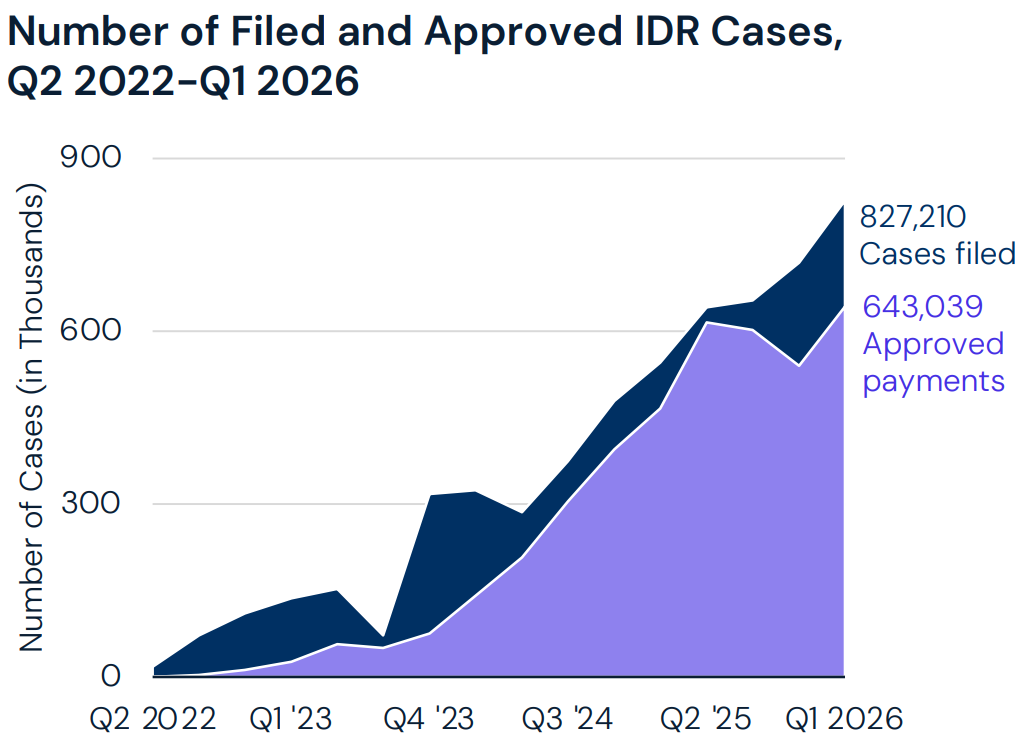
The growth in federal IDR activity illustrates the increasing financial significance of the No Surprises Act for certain providers. As shown in the graphic below, both the number of cases filed and the number of approved payments has increased substantially since the process began. In Q1 2026, approximately 827,000 cases were filed, and 643,000 approved payments were reported. The volume highlights how IDR has become a more prominent component of reimbursement for providers with significant out-of-network exposure.
Source: Trilliant
The data highlights key trends in the IDR process:
- IDR volume has increased dramatically. Approximately 827,000 cases were filed in Q1 2026, continuing the significant increase in dispute volume since the federal IDR process began. The trend suggests that IDR growth shows no signs of abating, indicating that providers and payers continue to rely heavily on the process to resolve reimbursement disputes.
- A substantial number of disputes are resulting in payments. The chart shows approximately 643,000 approved payments in Q1 2026, equivalent to roughly 78% of the number of cases filed during the quarter. This demonstrates that IDR activity is translating into actual reimbursement outcomes rather than simply accumulating as unresolved claims.
- Financial materiality is growing. For affected providers, the growing scale of the IDR process can materially influence reported revenue, accounts receivable, collection timing and EBITDA. The impact will vary based on the specialty, out-of-network exposure and success in collecting awarded amounts. As the volume and value of awards increase, IDR-related reimbursement may become an important consideration in financial and valuation analyses.
Why it Matters
- IDR benefits for certain providers have accrued suddenly. For certain out-of-network providers, favorable IDR determinations can generate sudden reimbursement materially above the QPA, creating rapid and incremental revenue and EBITDA. This can produce a meaningful change in reported financial performance over a relatively short period, particularly for providers with substantial out-of-network activity.
- The financial benefit can be significant. As dispute volumes have increased, IDR recoveries have become a more meaningful component of reimbursement for providers with substantial out-of-network exposure. Trilliant highlighted how neurology, imaging and NICU procedures have a history of awards significantly above the QPA. For providers in these areas, IDR recoveries may represent a meaningful source of incremental earnings rather than an isolated reimbursement adjustment.
- The sustainability of these economics remains uncertain. Payer strategies, litigation, collection uncertainties and changes to the administration of the IDR process could affect future recoveries. As a result, recent reimbursement levels may not provide a reliable indication of future revenue or earnings.
Health Care Valuation Takeaways
- Valuators must determine how much IDR-related revenue and EBITDA represents sustainable operating performance versus a reimbursement benefit that may not persist over the long term. Historical IDR recoveries may support current revenue and EBITDA, but valuation professionals should consider whether recent results are representative of sustainable future reimbursement. This assessment is important when determining normalized earnings and selecting financial periods that best reflect ongoing operations.
- If elevated IDR recoveries have materially increased recent EBITDA, valuators may evaluate IDR-related earnings separately from the provider’s underlying operating performance and determine whether all or only a portion should be evaluated with higher risk factors.
- Even when IDR revenue is expected to continue, greater uncertainty surrounding reimbursement and collectability could justify assigning a different risk profile to IDR-related earnings than to earnings generated through traditional contracted reimbursement. This distinction can affect the assumptions used to assess future cash flows and the risk associated with projected earnings.
- The impact of IDR varies significantly by specialty and payer mix. IDR awards may be delayed or disputed in periods after the related services are provided. Valuators should consider out-of-network volume, dispute concentration, payer mix, historical award patterns and collection timing. These factors can help determine whether reported IDR revenue is supported by a consistent pattern of recoveries or reflects more variable, case-specific outcomes.
As IDR recoveries become a more meaningful component of reimbursement for some providers, questions around sustainability, collectability and future reimbursement assumptions may become increasingly important. Weaver can evaluate how IDR-related revenue affects financial performance, normalized earnings and valuation conclusions. Contact us to discuss your health care valuation needs.
©2026
